/59748.tmb-300v.png?sfvrsn=9885965b_2 "For the future - publication thumbnail")


/countries/fiji/47618.tmb-1920v.jpg?sfvrsn=e6b809a5_1 1920w)
A basic dental check-up with diabetic patient in Suva, Fiji.
Oral health
Oral health is essential to overall health, well-being, and quality of life across the life course. It enables us to eat, speak and socialize in the community. Most oral diseases are preventable and can be treated in their early stages. Through reducing risk factors such as tobacco use, alcohol consumption, and unhealthy diets high in free sugars, many oral diseases and other noncommunicable diseases, such as cancer and diabetes, can be prevented.
Oral diseases are the most common noncommunicable diseases in the Western Pacific Region. In 2021, an estimated 960 million people or over 40% of the population were affected by oral diseases, including untreated dental caries (tooth decay), periodontal (gum) diseases, and tooth loss.
Oral health promotion and oral disease prevention should be integrated with broader noncommunicable disease prevention programmes that share common risk factors and social determinants. Integrating essential oral health services in primary health care as part of national Universal Health Coverage benefit packages is critical to provide more equitable access to comprehensive care.
The most common oral diseases and conditions are dental caries (tooth decay), periodontal (gum) diseases, tooth loss and oral cancer.
Dental caries result from plaque that forms on a tooth surface and converts the free sugars from foods and drinks into acids that cause a breakdown of tooth enamel over time. Unhealthy diets, including continuous consumption of free sugars, and poor oral hygiene lacking fluoride exposure and toothbrushing to remove plaque can lead to dental caries. Pain, infection and tooth loss can also result if not treated early.
Periodontal disease includes gingivitis and periodontitis. Gingivitis causes swollen, painful or bleeding gums and bad breath. In its more severe form, periodontitis causes a loss of connective tissue and bones resulting in tooth loss. The main causes of periodontal disease include poor oral hygiene and tobacco use.
Oral cancer is cancer that develops in the lip and all parts of the oral cavity, and oropharynx. The initial symptoms include a persistent ulceration, pain, swelling, bleeding of the soft tissue, and difficulty in eating or speaking. The risk factors include tobacco use, areca nuts or betel quid chewing, and excessive alcohol consumption.
Other oral diseases include cleft lip and palate, oral manifestation of HIV, and oro-dental trauma.
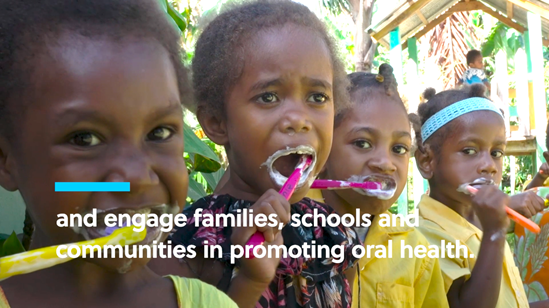
There is growing momentum on oral health in the WHO Western Pacific Region, following the global momentum on oral health.
At the 75th session of the WHO Regional Committee for the Western Pacific, Member States agreed on three regional priorities. Subsequently, the Western Pacific Regional Implementation Plan for the Global Strategy and Action Plan on oral health (WPR/RC76/6) and its resolution on oral health (WPR/RC76.R3) were endorsed at the 76th session of the Regional Committee. This regional implementation operationalizes the Global Strategy and Action Plan on Oral Health 2023–2030 and the Bangkok Declaration within the regional vision Weaving Health for Families, Communities and Societies.
WHO supports Member States in the Western Pacific by providing technical support to strengthen the workforce, integrate essential oral health services in primary health care as part of national Universal Health Care benefit packages, scale healthy settings in schools, workplaces and communities, link with noncommunicable disease prevention, and consolidate oral health policy and governance.
/campaigns/who-oral-health-infographics-04-01.tmb-549v.jpg?sfvrsn=eb1e7e6e_1)
/campaigns/who-oral-health-infographics-04-03.tmb-549v.jpg?sfvrsn=4f466f1b_1)
/campaigns/who-oral-health-infographics-04-02.tmb-549v.jpg?sfvrsn=f2bd4c39_1)